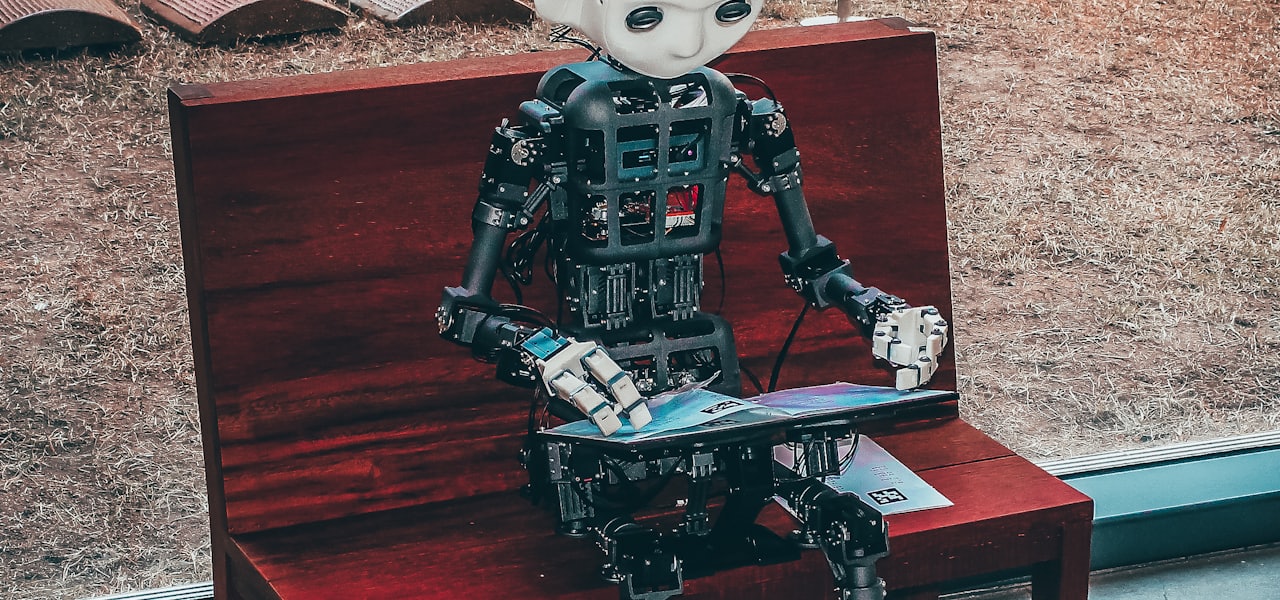
"Computing Machinery and Intelligence" is a paper written by Alan Turing on the topic of artificial intelligence. The paper, published in 1950 in Mind, was the first to introduce his concept of what is now known as the Turing test to the general public. Turing's paper considers the question "Can machines think?" Turing says that since the words "think" and "machine" cannot clearly be defined, we should "replace the question by another, which is closely related to it and is expressed in relatively unambiguous words." To achieve this objective, Turing proposes a three-step approach. First, he identifies a simple and unambiguous concept to substitute for the term "think." Second, he delineates the specific "machines" under consideration. Third, armed with these tools, he poses a new question related to the first, which he believes he can answer in the affirmative. == Turing's test == Rather than trying to determine if a machine is thinking, Turing suggests we should ask if the machine can win a game, called the "Imitation Game". The original Imitation game, that Turing described, is a simple party game involving three players. Player A is a man, player B is a woman and player C (who plays the role of the interrogator) can be of either sex. In the Imitation Game, player C is unable to see either player A or player B (and knows them only as X and Y), and can communicate with them only through written notes or any other form that does not give away any details about their gender. By asking questions of player A and player B, player C tries to determine which of the two is the man and which is the woman. Player A's role is to trick the interrogator into making the wrong decision, while player B attempts to assist the interrogator in making the right one. Turing proposes a variation of this game that involves the computer: We now ask the question, "What will happen when a machine takes the part of A in this game?" Will the interrogator decide wrongly as often when the game is played like this as he does when the game is played between a man and a woman? These questions replace our original, "Can machines think?" So the modified game becomes one that involves three participants in isolated rooms: a computer (which is being tested), a human, and a (human) judge. The human judge can converse with both the human and the computer by typing into a terminal. Both the computer and the human try to convince the judge that they are the human. If the judge cannot consistently tell which is which, then the computer wins the game. Researchers in the United Kingdom had been exploring "machine intelligence" for up to ten years prior to the founding of the field of artificial intelligence (AI) research in 1956. It was a common topic among the members of the Ratio Club, an informal group of British cybernetics and electronics researchers that included Alan Turing. Turing, in particular, had been running the notion of machine intelligence since at least 1941 and one of the earliest-known mentions of "computer intelligence" was made by him in 1947. As Stevan Harnad notes, the question has become "Can machines do what we (as thinking entities) can do?" In other words, Turing is no longer asking whether a machine can "think"; he is asking whether a machine can act indistinguishably from the way a thinker acts. This question avoids the difficult philosophical problem of pre-defining the verb "to think" and focuses instead on the performance capacities that being able to think makes possible, and how a causal system can generate them. Since Turing introduced his test, it has been both highly influential and widely criticised, and has become an important concept in the philosophy of artificial intelligence. Some of its criticisms, such as John Searle's Chinese room, are themselves controversial. Some have taken Turing's question to have been "Can a computer, communicating over a teleprinter, fool a person into believing it is human?" but it seems clear that Turing was not talking about fooling people but about generating human cognitive capacity. == Digital machines == Turing also notes that we need to determine which "machines" we wish to consider. He points out that a human clone, while man-made, would not provide a very interesting example. Turing suggested that we should focus on the capabilities of digital machinery—machines which manipulate the binary digits of 1 and 0, rewriting them into memory using simple rules. He gave two reasons. First, there is no reason to speculate whether or not they can exist. They already did in 1950. Second, digital machinery is "universal". Turing's research into the foundations of computation had proved that a digital computer can, in theory, simulate the behaviour of any other digital machine, given enough memory and time. (This is the essential insight of the Church–Turing thesis and the universal Turing machine.) Therefore, if any digital machine can "act like it is thinking", then every sufficiently powerful digital machine can. Turing writes, "all digital computers are in a sense equivalent." This allows the original question to be made even more specific. Turing now restates the original question as "Let us fix our attention on one particular digital computer C. Is it true that by modifying this computer to have an adequate storage, suitably increasing its speed of action, and providing it with an appropriate programme, C can be made to play satisfactorily the part of A in the imitation game, the part of B being taken by a man?" Hence, Turing states that the focus is not on "whether all digital computers would do well in the game nor whether the computers that are presently available would do well, but whether there are imaginable computers which would do well". What is more important is to consider the advancements possible in the state of our machines today regardless of whether we have the available resource to create one or not. == Nine common objections == Having clarified the question, Turing turned to answering it: he considered the following nine common objections, which include all the major arguments against artificial intelligence raised in the years since his paper was first published. Religious Objection: This states that thinking is a function of man's immortal soul; therefore, a machine cannot think. "In attempting to construct such machines," wrote Turing, "we should not be irreverently usurping His power of creating souls, any more than we are in the procreation of children: rather we are, in either case, instruments of His will providing mansions for the souls that He creates." 'Heads in the Sand' Objection: "The consequences of machines thinking would be too dreadful. Let us hope and believe that they cannot do so." This thinking is popular among intellectual people, as they believe superiority derives from higher intelligence and the possibility of being overtaken is a threat (as machines have efficient memory capacities and processing speed, machines exceeding the learning and knowledge capabilities are highly probable). This objection is a fallacious appeal to consequences, confusing what should not be with what can or cannot be (Wardrip-Fruin, 56). The Mathematical Objection: This objection uses mathematical theorems, such as Gödel's incompleteness theorem, to show that there are limits to what questions a computer system based on logic can answer. Turing suggests that humans are too often wrong themselves and pleased at the fallibility of a machine. (This argument would be made again by philosopher John Lucas in 1961 and physicist Roger Penrose in 1989, and later would be called Penrose–Lucas argument.) Argument From Consciousness: This argument, suggested by Professor Geoffrey Jefferson in his 1949 Lister Oration (acceptance speech for his 1948 award of Lister Medal) states that "not until a machine can write a sonnet or compose a concerto because of thoughts and emotions felt, and not by the chance fall of symbols, could we agree that machine equals brain." Turing replies by saying that we have no way of knowing that any individual other than ourselves experiences emotions, and that therefore we should accept the test. He adds, "I do not wish to give the impression that I think there is no mystery about consciousness ... [b]ut I do not think these mysteries necessarily need to be solved before we can answer the question [of whether machines can think]." (This argument, that a computer can't have conscious experiences or understanding, would be made in 1980 by philosopher John Searle in his Chinese room argument. Turing's reply is now known as the "other minds reply". See also Can a machine have a mind? in the philosophy of AI.) Arguments from various disabilities. These arguments all have the form "a computer will never do X". Turing offers a selection:Be kind, resourceful, beautiful, friendly, have initiative, have a sense of humour, tell right from wrong, make mistakes, fall in love, enjo
Stixel
In computer vision, a stixel (portmanteau of "stick" and "pixel") is a superpixel representation of depth information in an image, in the form of a vertical stick that approximates the closest obstacles within a certain vertical slice of the scene. Introduced in 2009, stixels have applications in robotic navigation and advanced driver-assistance systems, where they can be used to define a representation of robotic environments and traffic scenes with a medium level of abstraction. == Definition == One of the problems of scene understanding in computer vision is to determine horizontal freespace around the camera, where the agent can move, and the vertical obstacles delimiting it. An image can be paired with depth information (produced e.g. from stereo disparity, lidar, or monocular depth estimation), allowing a dense tridimensional reconstruction of the observed scene. One drawback of dense reconstruction is the large amount of data involved, since each pixel in the image is mapped to an element of a point cloud. Vision problems characterised by planar freespace delimited by mostly vertical obstacles, such as traffic scenes or robotic navigation, can benefit from a condensed representation that allows to save memory and processing time. Stixels are thin vertical rectangles representing a slice of a vertical surface belonging to the closest obstacle in the observed scene. They allow to dramatically reduce the amount of information needed to represent a scene in such problems. A stixel is characterised by three parameters: vertical coordinate of the bottom, height of the stick, and depth. Stixels have fixed width, with each stixel spanning over a certain number of image columns, allowing downsampling of the horizontal image resolution. In the original formulation, each column of the image would contain at most one stixel, and later extensions were developed to allow multiple stixels on each column, allowing to represent multiple objects at different distances. == Stixel estimation == The input to stixel estimation is a dense depth map, that can be computed from stereo disparity or other means. The original approach computes an occupancy grid that can be segmented to estimate the freespace, with dynamic programming providing an efficient method to find an optimal segmentation. Alternative approaches can be used instead of occupancy grid mapping, such as manifold-based methods. The freespace boundary provides the base points of the obstacles at closest longitudinal distance, however multiple objects at different distances might appear in each column of the image. To fully define the obstacles, their height should be estimated, and this is accomplished by segmenting the depth of the object from the depth of the background. A membership function over the pixels can be defined based on the depth value, where the membership represents the confidence of a pixel belonging to the closest vertical obstacle or to the background, and a cut separating the obstacles from the background can again be computed effectively with dynamic programming. Once both the freespace and the obstacle height are known, the stixels can be estimated by fusing the information over the columns spanned by each stixel, and finally a refined depth of the stixel can be estimated via model fitting over the depth of the pixels covered by the stixel, possibly paired with confidence information (e.g. disparity confidence produced by methods such as semi-global matching).
Query rewriting
Query rewriting is a typically automatic transformation that takes a set of database tables, views, and/or queries, usually indices, often gathered data and query statistics, and other metadata, and yields a set of different queries, which produce the same results but execute with better performance (for example, faster, or with lower memory use). Query rewriting can be based on relational algebra or an extension thereof (e.g. multiset relational algebra with sorting, aggregation and three-valued predicates i.e. NULLs as in the case of SQL). The equivalence rules of relational algebra are exploited, in other words, different query structures and orderings can be mathematically proven to yield the same result. For example, filtering on fields A and B, or cross joining R and S can be done in any order, but there can be a performance difference. Multiple operations may be combined, and operation orders may be altered. The result of query rewriting may not be at the same abstraction level or application programming interface (API) as the original set of queries (though often is). For example, the input queries may be in relational algebra or SQL, and the rewritten queries may be closer to the physical representation of the data, e.g. array operations. Query rewriting can also involve materialization of views and other subqueries; operations that may or may not be available to the API user. The query rewriting transformation can be aided by creating indices from which the optimizer can choose (some database systems create their own indexes if deemed useful), mandating the use of specific indices, creating materialized and/or denormalized views, or helping a database system gather statistics on the data and query use, as the optimality depends on patterns in data and typical query usage. Query rewriting may be rule based or optimizer based. Some sources discuss query rewriting as a distinct step prior to optimization, operating at the level of the user accessible algebra API (e.g. SQL). There are other, largely unrelated concepts also named similarly, for example, query rewriting by search engines.
Query rewriting
Query rewriting is a typically automatic transformation that takes a set of database tables, views, and/or queries, usually indices, often gathered data and query statistics, and other metadata, and yields a set of different queries, which produce the same results but execute with better performance (for example, faster, or with lower memory use). Query rewriting can be based on relational algebra or an extension thereof (e.g. multiset relational algebra with sorting, aggregation and three-valued predicates i.e. NULLs as in the case of SQL). The equivalence rules of relational algebra are exploited, in other words, different query structures and orderings can be mathematically proven to yield the same result. For example, filtering on fields A and B, or cross joining R and S can be done in any order, but there can be a performance difference. Multiple operations may be combined, and operation orders may be altered. The result of query rewriting may not be at the same abstraction level or application programming interface (API) as the original set of queries (though often is). For example, the input queries may be in relational algebra or SQL, and the rewritten queries may be closer to the physical representation of the data, e.g. array operations. Query rewriting can also involve materialization of views and other subqueries; operations that may or may not be available to the API user. The query rewriting transformation can be aided by creating indices from which the optimizer can choose (some database systems create their own indexes if deemed useful), mandating the use of specific indices, creating materialized and/or denormalized views, or helping a database system gather statistics on the data and query use, as the optimality depends on patterns in data and typical query usage. Query rewriting may be rule based or optimizer based. Some sources discuss query rewriting as a distinct step prior to optimization, operating at the level of the user accessible algebra API (e.g. SQL). There are other, largely unrelated concepts also named similarly, for example, query rewriting by search engines.
Reverse data management
Reverse data management describes a branch and set of research questions in relational database theory that aim to reverse the common focus of standard data management. Instead of focusing on the "forward" transformation of an input databases (a set of relational tables) to an output table, which is the main focus of standard query evaluation, reverse data management reverses that focus and studies the possible input database transformations that would achieve a desired output. Usually the objective is to find an intervention (a deletion, addition, or change of tuples) of minimal size, in order to achieve a particular change in the output. The problem has been studied at least since the 1980s, but has received renewed attention due to an influential paper in the early 2000s that made a connection between provenance and view propagation. The term was coined in a VLDB 2011 vision paper. The problem has been receiving significant attention in recent years due to its connection to computational fairness. == Topics in reverse data management problems == Example topics in reverse data management include: Deletion propagation with source side-effects: Find a minimal number of tuples to delete in the database in order to delete a particular tuple in the output. Deletion propagation with view side-effects: Find a set of tuples to delete in the database in order to delete a particular tuple in the output, while removing the minimal number of other output tuples. Causal responsibility: Find a minimal number of tuples to delete in the database in order to make a particular input tuple counterfactual. This notion is inspired by the notions of actual cause and causal responsibility from the work of Halpern and Pearl. Resilience: Find a minimal number of tuples to delete in the database in order to make a Boolean query false. The complexity of this problem is identical to the problem of deletion propagation with source-side effects over a different database. Smallest witness problem: Find a minimal number of tuples to keep in the a database (or equivalently, delete a maximal number of tuples) while keeping a particular tuple in the output. Minimum repair: Given a database that violates certain integrity constraints, find a minimal number of tuples to delete in the database in order to fulfill all constraints (also called to "repair" the database).
Artificial intelligence of things
Artificial Intelligence of Things (AIoT) is the combination of artificial intelligence (AI) technologies with the Internet of things (IoT) infrastructure to create systems capable of sensing, learning, and acting on data without continuous human intervention. While IoT focuses on connectivity and sensor data collection, AI enables IoT devices to analyse data in real time and produce actionable outputs, including automated decisions at the edge. == Applications == === Manufacturing and predictive maintenance === Manufacturing accounts for the largest share of AIoT adoption by industry vertical. A common application is predictive maintenance, where sensors measuring vibration, temperature, current draw, and acoustic emissions feed machine learning models trained to detect signatures that precede equipment failure. These systems can flag developing faults weeks or months in advance, and in more advanced deployments can autonomously adjust machine parameters such as motor speed or cooling cycles to delay or prevent failure. === Other industries === In healthcare, AIoT enables remote patient monitoring through wearable devices that collect vital signs and apply AI models to detect anomalies or predict deterioration. In logistics, GPS and telematics sensors combined with AI models support real-time route optimisation, vehicle maintenance prediction, and fuel cost forecasting. Smart building systems use occupancy, temperature, and energy sensors with AI to dynamically adjust HVAC and lighting, reducing energy consumption. == Architecture == AIoT systems typically operate across three layers: a device layer of sensors and actuators that collect data, a connectivity layer that transmits data via protocols such as MQTT or HTTP, and a compute layer where AI models process the data either in the cloud or at the edge. The trend toward edge-based processing, where inference runs on low-cost processors near the data source rather than in a centralised cloud, has accelerated as hardware costs have fallen and applications increasingly require sub-second response times. == Market == Market sizing estimates for AIoT vary significantly depending on scope and definition. Fortune Business Insights valued the AIoT market at USD 35.65 billion in 2023, projecting growth to USD 253.86 billion by 2030 at a compound annual growth rate of 32.4%. Grand View Research estimated the broader market at USD 171.4 billion in 2024 with a CAGR of 31.7% through 2030, reflecting a wider definition that includes AI-integrated hardware components. North America accounted for approximately 40% of global market share in 2024, with the Asia-Pacific region projected as the fastest-growing market.
Enterprise information integration
Enterprise information integration (EII) is the ability to support a unified view of data and information for an entire organization. The goal of EII is to get a large set of heterogeneous data sources to appear to a user or system as a single, homogeneous data source. In a data virtualization application of EII, there is a process of information integration, using data abstraction to provide a unified interface (known as uniform data access) for viewing all the data within an organization, and a single set of structures and naming conventions (known as uniform information representation) to represent this data. == Overview == Data within an enterprise can be stored in heterogeneous formats, including relational databases (which themselves come in a large number of varieties), text files, XML files, spreadsheets and a variety of proprietary storage methods, each with their own indexing and data access methods. Standardized data access APIs have emerged that offer a specific set of commands to retrieve and modify data from a generic data source. Many applications exist that implement these APIs' commands across various data sources, most notably relational databases. Such APIs include ODBC, JDBC, XQJ, OLE DB, and more recently ADO.NET. There are also standard formats for representing data within a file that are very important to information integration. The best-known of these is XML, which has emerged as a standard universal representation format. There are also more specific XML "grammars" defined for specific types of data such as Geography Markup Language for expressing geographical features and Directory Service Markup Language for holding directory-style information. In addition, non-XML standard formats exist such as iCalendar for representing calendar information and vCard for business card information. Enterprise Information Integration (EII) applies data integration commercially. Despite the theoretical problems described above, the private sector shows more concern with the problems of data integration as a viable product. EII emphasizes neither correctness nor tractability, but speed and simplicity. === Uniform data access === Uniform data access means connectivity and controllability across numerous target data sources. Necessary to fields such as EII and Electronic Data Interchange (EDI), it is most often used regarding analysis of disparate data types and data sources, which must be rendered into a uniform information representation, and generally must appear homogenous to the analysis tools—when the data being analyzed is typically heterogeneous and widely varying in size, type, and original representation. === Uniform information representation === Uniform information representation allows information from several realms or disciplines to be displayed and worked with as if it came from the same realm or discipline. It takes information from a number of sources, which may have used different methodologies and metrics in their data collection, and builds a single large collection of information, where some records may be more complete than others across all fields of data Uniform information representation is particularly important in EII and Electronic Data Interchange (EDI), where different departments of a large organization may have collected information for different purposes, with different labels and units, until one department realized that data already collected by those other departments could be re-purposed for their own needs—saving the enterprise the effort and cost of re-collecting the same information. === Combining disparate data sets === Each data source is disparate and as such is not designed to support EII. Therefore, data virtualization as well as data federation depends upon accidental data commonality to support combining data and information from disparate data sets. Because of this lack of data value commonality across data sources, the return set may be inaccurate, incomplete, and impossible to validate. One solution is to recast disparate databases to integrate these databases without the need for ETL. The recast databases support commonality constraints where referential integrity may be enforced between databases. The recast databases provide designed data access paths with data value commonality across databases. === Simplicity of deployment === Even if recognized as a solution to a problem, EII as of 2009 currently takes time to apply and offers complexities in deployment. Proposed schema-less solutions include "Lean Middleware". === Handling higher-order information === Analysts experience difficulty—even with a functioning information integration system—in determining whether the sources in the database will satisfy a given application. Answering these kinds of questions about a set of repositories requires semantic information like metadata and/or ontologies. == Applications == EII products enable loose coupling between homogeneous-data consuming client applications and services and heterogeneous-data stores. Such client applications and services include Desktop Productivity Tools (spreadsheets, word processors, presentation software, etc.), development environments and frameworks (Java EE, .NET, Mono, SOAP or RESTful Web services, etc.), business intelligence (BI), business activity monitoring (BAM) software, enterprise resource planning (ERP), Customer relationship management (CRM), business process management (BPM and/or BPEL) Software, and web content management (CMS). == Data access technologies == Service Data Objects (SDO) for Java, C++ and .Net clients and any type of data source XQuery and XQuery API for Java